(a short version was published by OpenGlobalRights)
The post-war global order is not just obsolete, it is now a weapon being used against us. And all this has led to a moment in which we must now confront the single greatest risk of geopolitical instability and of generational global crisis in the lifetime of anyone alive and in this room today. […].
Marco Rubio, US Secretary of State, 15 january 2025
As the liberal order is abandoned by the United States, the international human rights movement has not yet grasped the paradigm shift of our time, which brings two major challenges: first, adapting its international strategies, which remain dependent on governments to drive change; second, its financial dependence on public institutions, at a time when reduced funding has already led to the disappearance of a large number of NGOs. But is the dismantling of the international architecture since the Trump administration came to power permanent, or can we hope for the international system to return to equilibrium?
The United States’ Withdrawal from the International System
In seeking to explain why the anarchic international system organises itself, Nye and Keohane highlighted[1] in the early 2000s the driving role of the United States in creating international institutions (UN, NATO, the IMF). At the heart of their thesis is how globalisation and the growing interdependence of states give rise to a need for regulation, a need that manifests in the creation of international institutions. Moreover, they argue, these same structures, once built, in turn accelerate globalisation[2], a globalisation that brings new issues and new regulatory needs. It is therefore no coincidence that the number of international NGOs quadrupled between 1990 and 2000, rising from 6,000 to 26,000[3], and is estimated today at 78,000. In other words, the international system became less anarchic thanks to the United States, and the acceleration of globalisation then necessitated regulation, leading to a considerable growth in the number of NGOs alongside the interdependence of states within the multilateral system.
Yet US dominance has been steadily declining. First, economically: the de-dollarisation of international trade has continued to progress (72% of international transactions were conducted in dollars in 2000, falling to 57% in 2025). The role of international institutions has been steadily marginalised, as seen, for instance, with the World Trade Organisation (WTO), which in 2001 admitted China with the aim of expanding international trade. Although the accession negotiations were arduous, China was accepted within a liberal trade framework, an ideology of “win-win” in which everyone would be able to develop together. Two decades later, the organisation is stalled[4] and no longer central to regulating global economic exchanges. Indeed, President Trump’s anti-liberal policies, using tariff hikes as a political lever, are already producing a slowdown in economic activity in the US, which will ripple across the world. Unless a new country takes over the United States’ role as the engine of global growth, we are heading towards a worldwide decline in economic exchanges, and therefore fewer regulatory bodies, both governmental and non-governmental.
On the political front, Trump’s United States is also fuelling international disunity and distrust, undermining the UN. The president has, for example, pushed Canada, which he calls the “51st state of the USA“, to no longer regard itself as an ally. He has been threatening to annex Greenland, a move that even prompted a military response from the European Union. And the number of countries threatened with economic sanctions to achieve political ends, in violation of liberal ideals, is beyond counting. Moreover, the withdrawal from 66 international organisations and the creation of the “Board of Peace” leave no doubt: the US is disengaging from the UN system as a whole. These decisions, it should be noted, are part of a broader distrust of the multilateral international system that has been building since the 2000s, a distrust towards international justice that has accelerated, from Bush’s refusal to join the International Criminal Court (ICC), to the sanctioning of ICC judges under Trump. In the field of human rights, the most glaring example is the withdrawal from the UN Human Rights Council in Geneva under the Bush administration, followed by a return under Obama, another withdrawal under Trump I, a return under Biden, and yet another departure under Trump II.
De-globalisation, de-dollarisation, Trump’s decisions are, in reality, part of a deep-rooted desire to slow economic and political globalisation, even if that desire has admittedly varied depending on which party holds power. But the “America First” discourse has progressively reshaped the American perception of the country’s role in the world. Even a prominent Republican opponent of Donald Trump, Thomas Massie, wants to withdraw from NATO. Trump is part of a broader American movement that rejects the post-World War II system (the rules-based liberal order) and, by amplifying it, he has convinced Americans that the international system is contrary to their interests. With less intense economic and political exchanges, the multilateral system will require less regulation, and we will see, using Nye and Keohane’s theory, an increase in anarchy within the international system and a reduction in the size of both governmental and non-governmental international organisations.
Why the Human Rights Movement Can No Longer Rely on the International System
NGOs in the international human rights movement depend on the international system primarily for two reasons: to carry out their information and advocacy work, and to secure funding. First, the spaces offered by the international system enable international meetings where NGOs expand their networks and advocate before states and decision-makers, sharing their own findings and gathering first-hand information in return. Second, the international system allows NGOs to raise funds by meeting donors such as foundations and states. For the purposes of this article, the international system will be reduced to the UN alone [5].
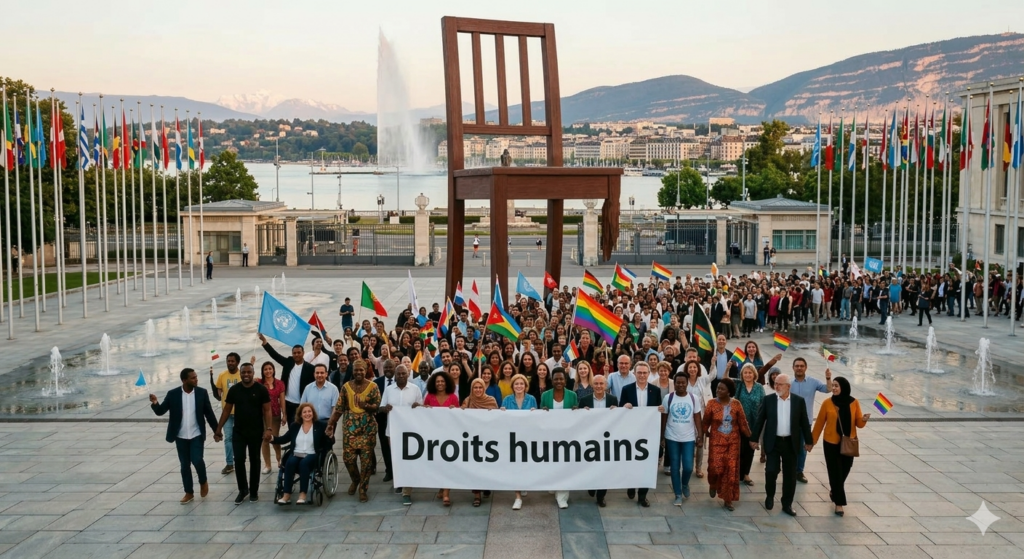
The UN system relies largely on the United States, which alone is theoretically responsible for 25% of the UN’s total budget. But the US is no longer meeting its obligations, to such an extent that the UN Secretary-General announced in January 2026 that the organisation faced the risk of “imminent financial collapse.” Some UN offices linked to human rights in Africa, for example, have already cut their budgets by 40% and halved their support operations at the start of 2026. National and local African NGOs have already begun to disappear. At the international level, the consequences are even worse: half of Special Rapporteurs’ visits have been cancelled for 2026, and treaty body sessions have already been called off.
Only two entities have the financial means to replace the United States: the EU and China. European countries have already made up some of the losses to the UN and to NGOs, but they will go no further, as they must also support Ukraine. Even if the war of Russia against Ukraine were to end, the EU’s budgetary efforts will continue to be directed towards the military sector in the coming years, as the United States is no longer perceived as a reliable ally; the EU will only be able to marginally increase its support to the UN. On the Chinese side, while the country claims to want to work with everyone to improve global human rights governance, China’s financial support for human rights will steer away from civil and political rights. The country will continue to support its own interests, such as financial assistance for the Special Rapporteur on terrorism, or economic, social and cultural rights, and perhaps environmental rights too.
Consequently, in the best-case scenario, international forums will prioritise economic and social rights. Although Western donors will continue to fund field projects for civil and political rights, they will give considerably less. The world’s largest development agency, USAID, has cut its activities by 85%, with the remainder redirected towards bilateral country support. With the rise of populism, the role of development agencies is already being called into question, as in France. Institutional national actors are reducing their support to small organisations, favouring large NGOs that redistribute to smaller ones, thereby diminishing the need for multilateral regulation. In the coming years, there will be fewer interactions between NGOs and states at the UN. NGOs working on first-generation rights will find it increasingly difficult to secure funding, and small NGOs engaged at the international level will gradually disappear. Finally, as nationalist and selfish regimes replace (temporarily?) universalist governments in the West, this trend will accelerate: many of the second Millennium Development Goals[6] will no longer be prioritised by Western countries. Some NGOs in Geneva are already seeing these dangers and are calling for the preservation of a crumbling multilateralism.
A Necessary Reinvention of Human Rights NGOs
As the international system’s need for regulation diminishes, international NGOs will have fewer meeting spaces, less financial support, and therefore less impact. But since international activities will shrink, would it be worthwhile to redirect efforts to the national level? It is worth noting that the expertise of international NGOs is rarely shared with the general public, even as Western democracies are increasingly tempted by “illiberal” forms of governance. It may therefore prove worthwhile to allocate a portion of international resources to strengthening citizens’ knowledge of democracy and the rule of law, areas in which NGOs have well-established expertise. And far greater priority should be given to the European Union, which is here to stay.
This is by no means a dead end. Benno Torgler has demonstrated that citizens’ distrust of their national institutions carries over to international bodies[7], a finding corroborated by the erosion of American public confidence in the UN, which fell from 61% in 2022 to 52% in 2024. If international NGOs work to strengthen the rule of law at the national level, they will indirectly help reduce distrust of international institutions. In the West, the human rights movement should strategically occupy social media and this new virtual democracy, which is becoming increasingly horizontal and egalitarian.
NGOs should also rely on private sector to support their activities.
Whatever the future of the United States, the upheavals within the international system are now too deep to be reversed. We do not know what kind of international system we are heading towards, but it is clear that the principles of solidarity and democracy will need to be defended more than ever. Some NGOs are better equipped than others to face the changes ahead, Amnesty International being one such example. It represents a model well-suited to a turbulent world, since it does not depend on governments or development agencies for its funding, and is made up of national chapters with grassroots activists. Its future role should be to support international activism, a mindset that has become increasingly rare as the international human rights movement has professionalised.
Références
- Robert O. Keohane and Joseph S. Nye, Jr., (2000), Globalization: What’s New? What’s Not? (And So What?), Foreign Policy(118), pp. 104–119[↩]
- “Globalization, therefore, does not merely affect governance; it is affected by governance”, ibid, pp. 113[↩]
- “The number of international NGOs more than quadrupled from about 6,000 to over 26,000 in the 1990s alone”, ibid, pp. 116[↩]
- “In reality, the WTO is breaking down, tolerating double standards and allowing members to play by different sets of rules. Asymmetry reigns instead of reciprocity.”, Mathias Döpfner, Politico[↩]
- This is not entirely fair, since NGOs organise meetings amongst themselves, and the European Union also exists; but as the UN is the subject of this analysis, and represents the main arena for action by NGOs working in the field of human rights, this simplification is consistent.[↩]
- Mostly the goal n°17.2: “Developed countries to implement fully their official development assistance commitments, including the commitment by many developed countries to achieve the target of 0.7 per cent of ODA/GNI to developing countries”[↩]
- “Countries’ capacity to act globally by creating international networks guaranteeing information, goods and capital flows increase the demand for international stability and the avoidance of a dangerous international environment. A safe environment guarantees that the international network is maintained. Such conditions may foster trust in international organizations as the UN.” Benno Torgler, Trust in international organizations: An empirical investigation focusing on the United Nations, The Review of International Organizations, Volume 3, 2008, p.69[↩]